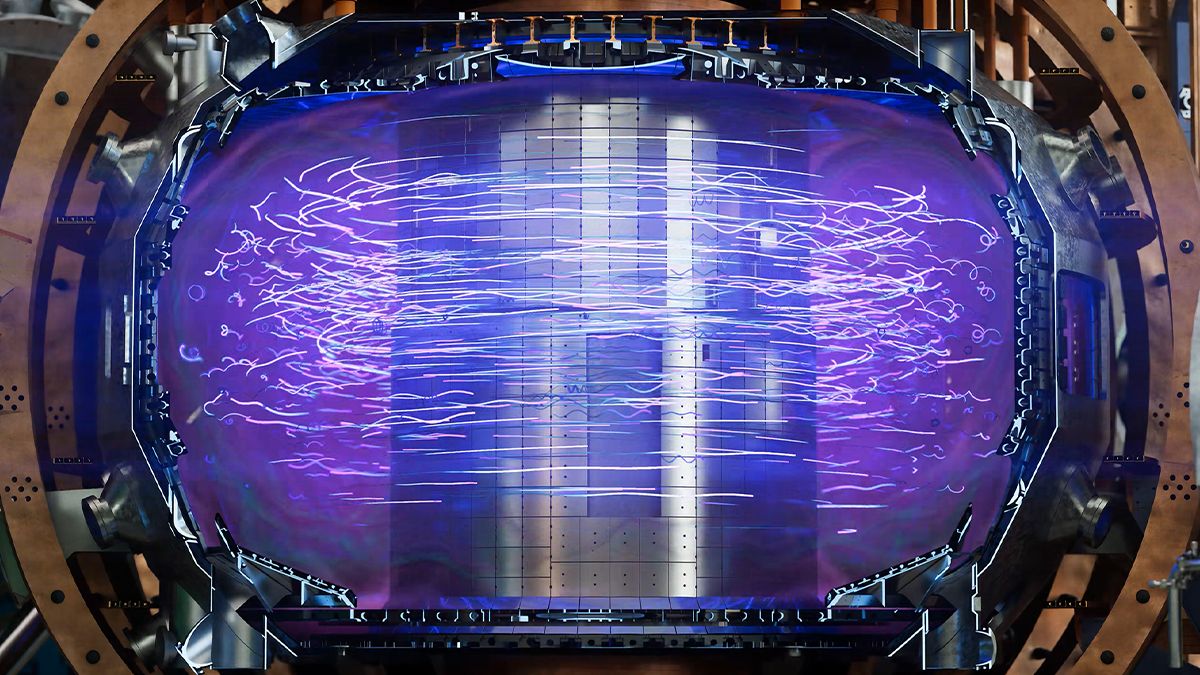
TL;DR: NVIDIA, General Atomics, and partners just unveiled an AI-enabled digital twin of the DIII-D National Fusion Facility. It slashes key plasma predictions from weeks down to seconds, letting researchers run interactive “what-if” experiments and iterate way faster toward practical fusion energy. Announced October 28, 2025 at NVIDIA GTC in Washington, D.C.
What’s New
NVIDIA and General Atomics have built a fully interactive, AI-enabled digital twin of the DIII-D National Fusion Facility—the first of its kind for fusion research. Developed with UC San Diego’s San Diego Supercomputer Center, Argonne Leadership Computing Facility (ALCF), and NERSC at Lawrence Berkeley National Laboratory, this high-fidelity virtual replica fundamentally changes how fusion research is conducted.
The system features three AI surrogate models—EFIT for plasma equilibrium, CAKE for plasma boundary, and ION ORB for escaping-ion heat density—trained at scale on the Polaris and Perlmutter supercomputers. The result? What used to take weeks now happens in seconds.
Bottling a Star
Fusion promises virtually limitless, clean energy by replicating the stellar processes that power the sun. The challenge is controlling plasma—the fourth state of matter, a swirling soup of charged particles heated to hundreds of millions of degrees. Plasma behaves almost like a living organism. “Imagine trying to bottle a star,” fusion scientists say. It’s both poetic and accurate.
Traditional physics-based simulations took weeks on the fastest supercomputers. General Atomics’ AI models, trained on decades of real DIII-D data and running on NVIDIA GPUs, now deliver the same predictions in seconds while helping operators keep plasma stable and reduce reactor damage risk.
“The ability to explore scenarios virtually through this interactive digital twin is a game-changer,” said Raffi Nazikian, fusion data science lead at General Atomics. “We can now test, refine and verify our ideas orders of magnitude faster, accelerating the path toward practical fusion energy.”
How It Works
Built inside NVIDIA Omniverse and powered by RTX PRO Servers and DGX Spark with CUDA-X libraries, the digital twin dynamically fuses sensor data, physics simulations, engineering models, and AI surrogates into a unified, real-time environment. It synchronizes with the physical DIII-D reactor, allowing 700 scientists from 100 organizations to test ideas without touching the real machine.
| Layer | What It Does |
|---|---|
| Data + Sensors | Live and historical DIII-D measurements |
| Physics & Engineering | Equilibrium, boundaries, and component behavior |
| AI Surrogates | Lightning-fast predictions replacing weeks-long simulations |
| Compute Platform | Omniverse on RTX PRO/DGX Spark; trained on Polaris/Perlmutter |
| Human-in-the-Loop | Interactive “what-if” studies to shape experiments and reduce risk |
Researchers can explore damage-risk scenarios virtually, refine control strategies, and optimize experimental “shots” in a completely safe environment before running physical experiments.
What This Enables
- Real-time control systems: AI models managing plasma equilibrium, boundaries, and heat loads during operations.
- Rapid design iteration: A shared environment to test divertors, plasma-facing materials, and operating scenarios before building.
- Scalable blueprint: A template for digital twins of other fusion devices and future pilot plants.
The Honest Question Marks
- Model limits: AI surrogates need verification beyond their training regimes. Error bounds aren’t published yet.
- Integration depth: Details on closed-loop, real-time coupling remain high-level; specific performance metrics are pending.
- Reproducibility: Access to models, datasets, and benchmarking protocols hasn’t been specified—critical for community validation.
What to Watch
- Peer-reviewed results comparing AI surrogates against traditional physics codes across different plasma conditions.
- Real-world improvements at DIII-D: faster equilibrium reconstructions, better heat-flux predictions during transients.
- Broader adoption: Will other tokamaks and stellarators implement this approach? How will it integrate with national fusion data platforms?
Bottom line: This digital twin compresses the timeline from exploration to implementation, acting as a true “fusion accelerator” that could put commercial fusion energy within reach sooner than expected. As the race to bottle a star intensifies, AI may be the breakthrough that finally makes fusion power real.
Learn More:
- NVIDIA Official Announcement
- General Atomics DIII-D Program
- NVIDIA Omniverse Platform
- US Department of Energy Fusion Programs

