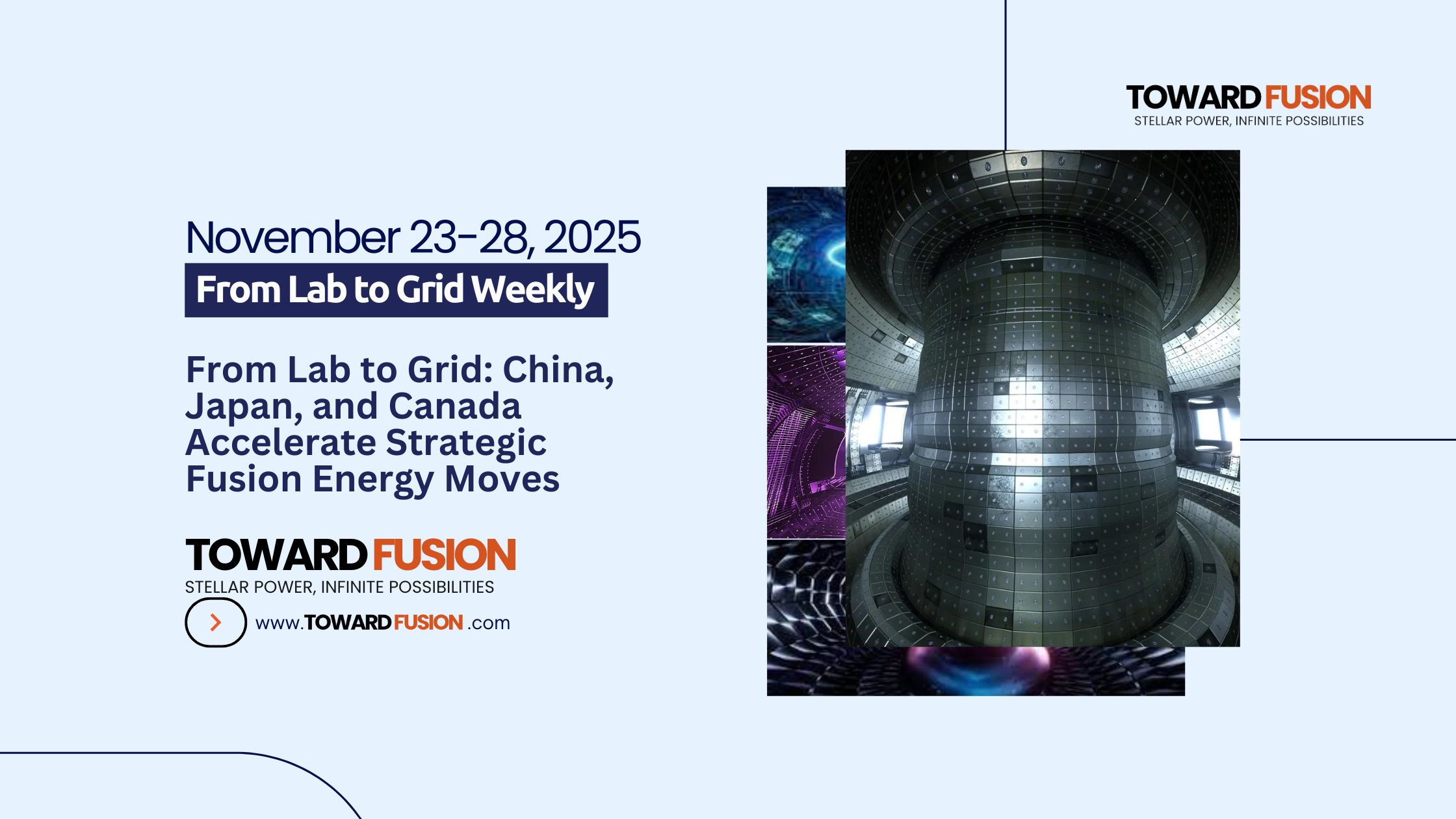
(From Lab to Grid Weekly: November 23-29, 2025) Global Strategic Positioning: China Opens Facilities, Japan Commits Billions, Canada Builds Ecosystem
Last week brought unprecedented international strategic positioning in fusion energy, with China launching a major international collaboration program, Japan designating fusion as a national strategic technology with ¥100 billion+ in funding, Canada establishing a comprehensive fusion center, and continued momentum in private sector development and workforce initiatives. The convergence of these developments reveals fusion’s evolution from research collaboration to competitive national industrial strategy across multiple major economies simultaneously.
China Launches International Burning Plasma Program
BEST Facility Opens to Global Research Community
On November 24, the Chinese Academy of Sciences officially launched the “Burning Plasma” International Science Program in Hefei, Anhui Province, while unveiling the research plan for the Burning Plasma Experimental Superconducting Tokamak (BEST) facility. [Xinhua] [CGTN] [China Minutes]
The program represents a significant shift in China’s fusion strategy—from primarily domestic development to leadership of an international collaborative research initiative opening multiple large-scale fusion platforms to global scientists.
Hefei Fusion Declaration
At the launch event in Hefei’s “Future Big Science City,” fusion scientists from more than 10 countries including France, the United Kingdom, Germany, Italy, Switzerland, Spain, Austria, and Belgium jointly signed the Hefei Fusion Declaration, pledging to promote open science, encourage international cooperation, and support researchers worldwide joining fusion research efforts in China.
Jerome Bucalossi, Director of the Institute for Research into Fusion by Magnetic Confinement at France’s CEA (Alternative Energies and Atomic Energy Commission), and Gianfranco Federici, EUROfusion Program Manager, participated in the launch ceremony—signaling European engagement with China’s fusion initiative despite broader geopolitical tensions.
BEST Facility Specifications and Timeline
The BEST device—China’s next-generation “artificial sun”—is scheduled for completion by the end of 2027. According to the research plan:
- Fusion Power Output: 20 to 200 megawatts, targeting net energy gain (Q>1)
- Experimental Focus: Deuterium-tritium burning plasma experiments demonstrating sustained fusion reactions where alpha particle heating maintains plasma temperature
- Operational Mode: Long-pulse, steady-state operation capability testing
- Technical Challenge: Exploring “uncharted territory” with major engineering and physics challenges, particularly understanding alpha particle transport mechanisms critical for maintaining ultra-high temperatures
Song Yuntao, Vice President of the Hefei Institutes of Physical Science and Director of the Chinese Academy of Sciences’ Institute of Plasma Physics (ASIPP), emphasized the program’s significance: “We are entering a new stage of burning plasma, which is critical for future fusion engineering. A burning plasma is like a flame sustained by the heat generated within the fusion reaction itself, forming the foundation for continuous power generation.”
Platform Access and Open Research Framework
The International Science Program will provide global researchers access to multiple major Chinese fusion research facilities beyond BEST:
- EAST (Experimental Advanced Superconducting Tokamak): The all-superconducting tokamak that has repeatedly broken world records for sustained high-temperature plasma confinement
- EAST Auxiliary Heating Systems: Advanced plasma heating and current drive systems
- Comprehensive Research Facility for Fusion Reactor Technologies (CRAFT): Integrated testing facility for fusion components and materials
The program will establish open research funds, facilitate high-frequency expert exchanges, and support collaborative projects addressing frontier challenges in fusion burning physics. ASIPP has existing stable partnerships with more than 120 scientific institutions across over 50 countries, with joint centers operational with France, Russia, and the United States.
Strategic Context and Implications
China’s launch of an international fusion program represents a sophisticated strategic move that serves multiple objectives simultaneously:
- Scientific Leadership: Positioning China as the convener and host of cutting-edge burning plasma research places Chinese institutions at the center of global fusion knowledge networks.
- Soft Power: Open access to advanced research facilities builds scientific goodwill and positions China as a collaborative partner in critical global challenges.
- Talent Attraction: Access to world-class facilities and ambitious experimental programs attracts top international fusion talent to Chinese institutions.
- Technology Development: Hosting international researchers on Chinese facilities accelerates domestic technology development through knowledge exchange while ensuring Chinese researchers benefit from global expertise.
- Standard Setting: As host of major international experiments, China gains influence over experimental protocols, data sharing standards, and best practices that could shape the broader field.
The timing is particularly significant given intensifying U.S.-China technology competition. While the U.S. recently created a standalone DOE Office of Fusion focused on commercialization, China emphasizes international collaboration on fundamental burning plasma science—a strategic differentiation that positions the two superpowers on complementary rather than directly competitive pathways.
Japan Designates Fusion as National Strategic Technology
¥100 Billion+ Commitment Across Strategic Tech Sectors
On November 25, Japan’s government announced plans to designate six fields including artificial intelligence, nuclear fusion, biotechnology, space, quantum computing, and advanced semiconductors as “national strategic technologies,” with approximately ¥400 billion ($2.6 billion USD) allocated in supplementary budget for fiscal year 2025. [The Japan News] [Nikkei Asia] [Quantum Insider]
More than ¥100 billion ($660 million USD) is specifically designated for fusion projects when including spending planned beyond this fiscal year, according to The Japan News reporting.
Budget Allocation Across Strategic Technologies
The ¥400 billion supplementary budget breaks down as follows:
Quantum Technology: Roughly ¥130 billion ($855 million) to support quantum research, including new R&D bases at AIST (National Institute of Advanced Industrial Science and Technology) and enhanced collaboration among domestic quantum hubs.
Artificial Intelligence: Approximately ¥190 billion ($1.25 billion) for AI initiatives, including:
- ¥45 billion ($296 million) for using AI to support scientific discovery
- ¥25.3 billion ($167 million) for AI-powered robots and autonomous driving
- ¥4.4 billion ($29 million) for government AI adoption
Nuclear Fusion: More than ¥100 billion ($660 million) for fusion research and related startup support, recognizing fusion’s potential as a carbon-free energy source despite remaining commercially unproven.
Strategic Framework and Implementation
The designation as “national strategic technologies” triggers several policy mechanisms:
- Multi-Year Budget Frameworks: Ministers overseeing each sector will formulate long-term budget plans extending beyond annual appropriations, providing funding certainty for multi-year R&D programs.
- Public-Private Investment Roadmaps: Government will compile detailed roadmaps specifying targets, funding amounts, schedules, and expected GDP contributions for each strategic sector.
- Regulatory Streamlining: Deregulation policies and investment promotion measures tailored to accelerate development and deployment in strategic sectors.
- Procurement Expansion: Government procurement commitments, particularly in defense-related areas, creating demand signals for emerging technologies.
- Talent Cultivation: Cross-sector strategies for startup support and talent development addressing workforce constraints across strategic technologies.
Political Context: PM Takaichi’s Technology Vision
The fusion commitment aligns with Prime Minister Sanae Takaichi’s political platform, which emphasizes “crisis management investment” in strategic technologies essential for Japan’s energy security and economic competitiveness. Takaichi, confirmed in office October 21, has publicly championed fusion alongside AI, semiconductors, and biotechnology as pillars of Japan’s technological sovereignty.
This represents a significant policy continuity and acceleration from former PM Shinzo Abe’s strategic vision, with Takaichi—widely regarded as Abe’s protégé—pursuing an even more ambitious technology-led industrial strategy.
Complementary U.S.-Japan Fusion Cooperation
Japan’s domestic fusion commitment complements the U.S.-Japan Technology Prosperity Deal signed October 28, which established formal cooperation frameworks for fusion development including:
- Joint R&D leveraging Japan’s JT-60SA tokamak (world’s largest superconducting tokamak)
- Collaboration on supply chains for magnets and high-power components
- Fuel cycle and blanket integration systems development
- Neutronics modeling and fusion materials advancement
The combination of substantial domestic funding (¥100+ billion) and bilateral U.S. cooperation positions Japan as a major player in global fusion development, leveraging its strengths in advanced materials, precision manufacturing, and system integration.
Canada Establishes Centre for Fusion Energy
$19.5M Ontario Investment Anchors National Ecosystem
This week, Ontario announced a $19.5 million CAD commitment to establish a Centre for Fusion Energy in partnership with Atomic Energy of Canada Limited (AECL), Canadian Nuclear Laboratories (CNL), Ontario Power Generation (OPG), and Stellarex Group. [AECL] [Ontario Government]
The federal government, through AECL and CNL, is contributing $33 million CAD in research activities over three years, bringing total initial public investment to approximately $52.5 million CAD.
Centre for Fusion Energy Structure and Objectives
The Centre represents a public-private partnership designed to create a robust and integrated Canadian fusion ecosystem with multiple strategic objectives:
- Industrial Readiness: Building supply chain capabilities, manufacturing expertise, and quality assurance processes necessary for fusion component production and plant deployment.
- Regulatory Framework: Developing fusion-specific regulatory approaches that appropriately address fusion’s safety profile while enabling timely licensing and deployment.
- Workforce Development: Training the specialized technical workforce—physicists, engineers, technicians, project managers—required for fusion commercialization.
- Technology Development: Advancing domestic fusion energy capabilities through targeted R&D addressing critical path challenges.
- Investment Attraction: Positioning Canada as a preferred destination for fusion investment by establishing supporting infrastructure, regulatory clarity, and collaborative frameworks.
Broader Canadian Fusion Strategy
The Centre for Fusion Energy represents one component of a comprehensive Canadian fusion strategy that includes multiple coordinated investments:
General Fusion Support: Federal backing for Burnaby, British Columbia-based General Fusion, which is developing magnetized target fusion technology and planning a demonstration plant in the UK.
Fusion Fuel Cycles Joint Venture: Investment in Fusion Fuel Cycles, a joint venture between Canadian Nuclear Laboratories and Japan’s Kyoto Fusioneering, pursuing the UNITY-2 test facility for demonstration of complete fusion fuel cycles (tritium breeding, processing, recycling). The facility is planned for Chalk River Laboratories in Ontario.
Research Infrastructure: Leveraging Canada’s nuclear research heritage, including CNL’s expertise in tritium handling, materials testing, and nuclear safety—capabilities directly applicable to fusion development.
Strategic Positioning: G7 Energy Superpower Ambition
Natural Resources Minister Jonathan Wilkinson framed the Centre as essential to Canada’s broader ambition: “Advancing Canadian leadership in fusion energy is part of the federal government’s commitment to establishing Canada as an energy superpower and the strongest economy in the G7.”
This positioning reflects Canada’s strategic advantages:
- Energy Abundance: Existing clean electricity generation capacity (primarily hydro and nuclear) providing reliable baseload power that fusion would complement rather than disrupt.
- Nuclear Expertise: Decades of CANDU reactor development, operation, and regulation providing transferable knowledge for fusion.
- Materials and Mining: Domestic access to critical materials required for fusion systems, reducing supply chain vulnerabilities.
- Collaborative Tradition: History of international nuclear cooperation (AECL partnerships, isotope production) establishing frameworks applicable to fusion collaboration.
- Geographic Position: Proximity to both U.S. fusion development and access to Atlantic markets positions Canada advantageously for North American fusion deployment.
Stellarex Group Partnership Significance
The inclusion of Stellarex Group—a private fusion company—as a founding partner alongside government entities (AECL, CNL, OPG) signals Canada’s commitment to public-private fusion development models. Stellarex brings entrepreneurial agility and private capital to complement government research infrastructure and regulatory expertise.
This partnership structure mirrors successful models in other jurisdictions where government research organizations (like UK’s UKAEA) collaborate closely with private fusion companies, creating symbiotic relationships that accelerate both fundamental research and commercial development.
Private Sector and Workforce Development
Maritime Fusion Raises $4.5M for Ship-Based Fusion
Maritime Fusion, a startup developing ship-based fusion power systems, announced a $4.5 million funding round this week, demonstrating continued investor interest in specialized fusion applications beyond grid power generation. [Maritime Fusion]
Ship-based fusion targets a specific market opportunity: providing compact, powerful, emission-free propulsion and power for large maritime vessels. The maritime sector faces increasing regulatory pressure to reduce emissions, with the International Maritime Organization targeting 50% emission reduction by 2050 compared to 2008 levels. Fusion could provide continuous high power output without the weight and space penalties of batteries or the emissions of conventional fuels.
UKAEA Launches STEP Forward Schools Programme
The UK Atomic Energy Authority (UKAEA) launched the “STEP Forward” schools programme this week, introducing fusion science and careers to students across the UK as part of workforce pipeline development for the Spherical Tokamak for Energy Production (STEP) program. [UKAEA]
The programme includes classroom materials, virtual facility tours, scientist interactions, and hands-on experiments designed to inspire the next generation of fusion scientists, engineers, and technicians. With STEP targeting a prototype fusion power plant by the early 2040s, workforce development initiatives like STEP Forward address a critical long-term challenge: ensuring sufficient skilled personnel are available as fusion transitions from research to deployment.
Workforce development represents an often-overlooked bottleneck in fusion commercialization. Multiple companies and programs will require thousands of specialized workers simultaneously—physicists, materials scientists, electrical engineers, controls specialists, vacuum technicians, cryogenic specialists, radiation protection professionals, and project managers with fusion-specific expertise. Early pipeline development through programs like STEP Forward helps ensure workforce availability doesn’t constrain deployment timelines.
Convergence: National Strategies and Global Competition
This week’s developments collectively reveal fusion’s fundamental transformation from international collaborative research endeavor to arena of national strategic competition:
China’s Strategy: Opening domestic facilities to international collaboration positions China as scientific convener while accelerating domestic capabilities through knowledge exchange. The emphasis on burning plasma—the next critical frontier after ignition—focuses resources on challenges directly relevant to commercial deployment.
Japan’s Approach: Designating fusion as a national strategic technology with ¥100+ billion in funding signals long-term commitment backed by substantial resources. The combination of domestic investment and U.S. partnership hedges technological risk while leveraging complementary strengths.
Canada’s Path: Building comprehensive fusion ecosystem infrastructure (Centre for Fusion Energy, fuel cycle facilities, General Fusion support) positions Canada to capture economic value across the fusion supply chain rather than focusing solely on reactor development.
U.S. Evolution: Recent creation of standalone DOE Office of Fusion (November 20-21) signals policy prioritization, though detailed funding frameworks remain under development.
European Positioning: Recent equity investments in Marvel Fusion and Focused Energy (€10-30M each via EIC STEP Scale Up, November 19) demonstrate European commitment to technology diversification across multiple fusion approaches.
UK Focus: Continued emphasis on spherical tokamaks through STEP program, workforce development through STEP Forward, and HTS magnet leadership via Tokamak Energy represents concentrated bet on specific technological pathway with supporting ecosystem development.
Implications for Global Fusion Race
The simultaneous emergence of multiple national fusion strategies with substantial funding commitments fundamentally changes the competitive dynamics:
Acceleration Through Competition: National pride and strategic positioning create political imperatives for visible progress, potentially accelerating timelines as governments compete for “first commercial fusion plant” achievements.
Technology Diversification: Different nations pursuing different technological approaches (China: burning plasma tokamaks; UK: spherical tokamaks; Germany: laser fusion; U.S.: multiple pathways) increases probability that at least one approach succeeds commercially while hedging against technical dead-ends.
Supply Chain Fragmentation Risk: Each nation building domestic fusion supply chains could lead to fragmentation, inefficiency, and duplication rather than globally optimized production—though it may also build resilience against supply disruptions.
Talent Competition: Multiple well-funded national programs competing for limited fusion expertise could drive compensation inflation and talent mobility, benefiting individual researchers while potentially slowing progress if critical expertise becomes fragmented.
Standards and Interoperability: Diverging national approaches may complicate international standards development, regulatory harmonization, and technology transfer—though organizations like IAEA provide coordination mechanisms.
The mid-2030s timeline for commercial fusion deployment appears increasingly credible as technical capabilities advance and multiple governments commit substantial resources with concrete commercialization targets. However, success will require not only technical breakthroughs but also sustained political commitment through multiple budget cycles, effective international collaboration despite competitive dynamics, and systematic buildout of supporting infrastructure across workforce, supply chains, and regulatory frameworks.
Major Sources:
- Xinhua – China Burning Plasma Program
- CGTN – China Fusion Program
- The Quantum Insider – Japan Strategic Tech
- Nikkei Asia – Japan Fusion Designation
- AECL – Canada Centre for Fusion Energy
- UKAEA – STEP Forward Programme

